
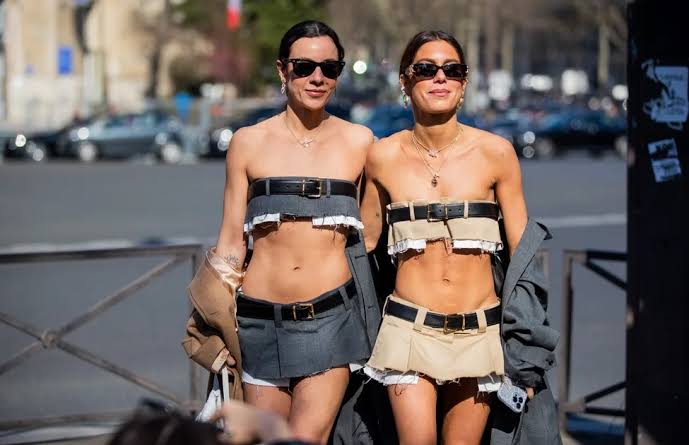
A few days ago, I was shopping for sports clothes, more specifically for gym clothes. I struggled to find something that wasn’t super revealing. It was butt-scrunch leggings everywhere. I couldn’t find a brand without it.
Also, almost every brand sells micro bras that aren’t made for movement at all. They’re not compressive and are too small. If you do one movement, like if you lift your arms, which is very common when you do sport, everything is out.
I even saw something worse! Clothes highlighting women’s body parts with different materials, colors, or contrasting seams.
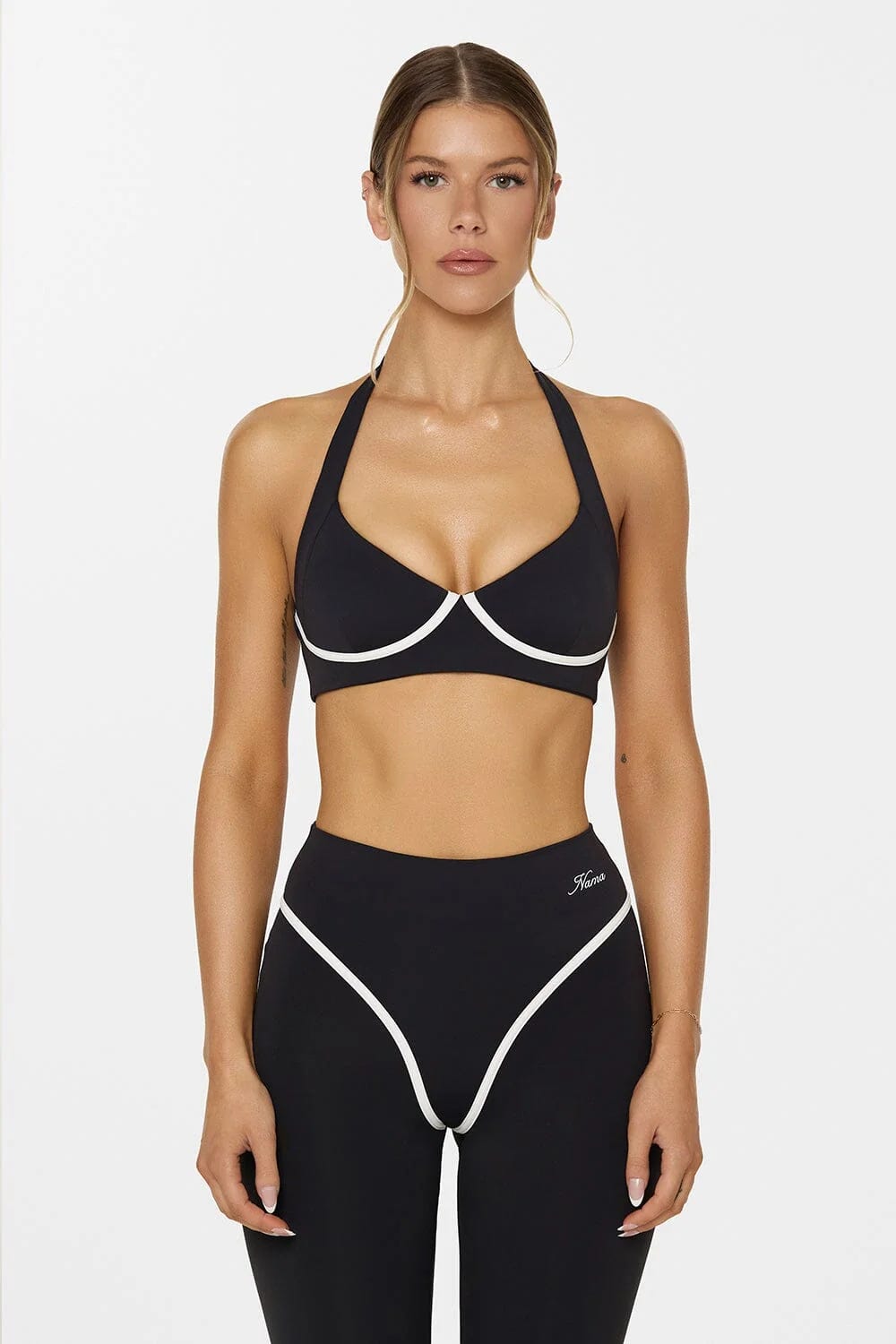
And this is not just the case for gym clothes; it’s women’s clothes in general. There’s a tendency to do everything shorter, tighter, in ways that were not imaginable just a few years or decades ago.
Take the micro skirt, for instance. How can we properly function in this? How can we talk, sit, and I don’t even mention running? Take women’s tops. Very cropped, very tight, very plunge, or transparent. Take women’s underwear. It’s not made for coverage or comfort at all, compared to men’s boxers. Same thing with women’s bikinis. Some barely cover anything. It can be almost impossible to move without everything being out, and obviously you cannot wear them without feeling like you have to shave absolutely everything the night before.
If brands produce these clothes more and more, it’s because women want it and women buy it. But why do so many women wear these clothes? Tight, short, transparent, plunging, revealing in some kind of way. Why is it specific to women?
Because we don’t see that for men. If you look at people running, at the gym, or doing any exercise, you’ll notice that men are wearing loose shorts down to their knees and loose T-shirts. Yes, you’ll probably see some guys at the gym with stringer tank tops to flex and show their muscles, but that’s a very small group of people across all sport categories. Women wear micro bras and super tight leggings or shorts, often with the butt scrunch.
If you look at people at the pool or at the beach. Men wear loose shorts as well. Women wear bikinis that barely cover anything. If you look at people going out, you’ll see men wearing shirts or polo shirts with straight pants, while women wear tight mini dresses, skirts, or shorts with a crop top, a transparent top, or a top with a very low neckline. Even if you go out in the middle of the day, you’ll see pretty much the same thing.
I’m not saying it as a judgement at all. Just as an observation. Also, I’m also not saying all women and all men, but enough people that we can fairly say that it’s a pattern. And I think anyone living in the US, the UK, Europe, or Canada has made that observation as well.
You’ll be surprised, but the difference in clothing has been the subject of research, and it confirms that observation. A study done by two psychologists in 2021 confirmed that this kind of clothing is mainly worn by women. They called it PDR clothing: painful, distracting, or restrictive. Painful clothing is clothing that hurts. Distracting clothing is clothing you have to think about and adjust all day because it’s impractical and inconvenient. Restrictive clothing is clothing that doesn’t let you move and function properly.
They surveyed nearly 800 people in the US, including college students and working adults. And they found that women were between 2 and 12 times more likely than men to wear painful, distracting, or restrictive clothing.
For women, these clothes are:
- Painful: heels, corsets, tight bras, or anything that hurts you physically.
- Distracting: strapless tops that can go down, mini skirts that can ride up, or transparent clothes you have to check. It’s basically anything you have to monitor and readjust during the day, distracting you from your activities.
- Restrictive: tight dresses, mini skirts, over-the-shoulder tops, corsets, bikinis. Basically anything that makes you unable to walk, sit, bend, lift your arms, or move properly.
These are pretty common clothes for women. I’d be willing to bet that probably every woman has one of these in her closet.
The study then asked men and women the reason why they wear painful, distracting, or restrictive clothing. And guess what happened.
When men wear painful, distracting, or restrictive clothing, do you know what it is? Suits, ties, and formal shoes. That’s it. So when men wear this kind of clothing, it’s usually for work or special occasions. It’s when there’s a dress code. When it’s imposed on them.
But when women wear this kind of clothing, it’s much more common in everyday life. And it’s often our own choice. Women in the study said they wear these clothes because they want to look beautiful. And I think that’s the case for most of us as well, right? Women wear revealing, uncomfortable, impractical, and inconvenient clothes because they want to feel attractive, feminine, desirable, or beautiful.
The reason is that in our society, women are valued primarily for their appearance. That’s why doing skincare is important. That’s also why most women wear makeup, do their hair, do their nails, or wear accessories. Men are valued for other things, primarily their physical strength, status, and money.
But the question then is: why does wearing revealing clothes mean being beautiful? Why does being attractive equal wearing these clothes and not others? Why does wearing a mini skirt make you more beautiful than wearing baggy jeans? Why does wearing a tight dress make you more beautiful than wearing a sweater?
Well, you guessed it. Because it shows your body.
Since the 1960s, we see these clothes as liberation from traditional norms, from modesty, and from old expectations put on women. We see them as rebellion against religion. We see them as bodily autonomy and as freedom from oppression. But is it really?
As I said, these clothes make it so hard for women to function as proper human beings. They’re designed and worn mainly for appearance. Not for comfort or functionality. We wear clothes that make ordinary movement difficult. We spend money on clothes we cannot properly function in. From a practical perspective, it doesn’t look like freedom to me. It’s an inconvenience that we have normalized for the sake of being beautiful and “liberated”. Yes, you might look beautiful. But if you cannot sit, walk, breathe, lift your arms, or move naturally, then the outfit is not only making you beautiful. It’s also limiting you. You become a beautiful plant in the corner of a room.
And that’s the question I want us to ask honestly: is that really liberation? Is it really empowerment if you can’t properly move? Does it really give you more freedom or less? Does it remove pressure, or does it add more?
Because physically, a lot of these clothes are not liberating. They’re inconvenient. They’re tight, restrictive, painful, distracting, or hard to move in. You have to pull them down, pull them up, check if something is showing, sit a certain way, walk a certain way, shave everything, adjust everything, and monitor yourself all day. So we call it liberation, but in practice, it looks more like a new form of restriction to me.
Apart from the physical restriction and discomfort, there’s another cost for women that’s way deeper. A lot of women do not want to be reduced to their bodies, right? We do not want to be seen as sexual objects. We want to be respected for our intelligence, character, competence, creativity, values, work, and personality. And that’s completely legitimate.
But at the same time, a lot of women’s clothing is deeply sexualized. Mini shorts, micro skirts, plunge tops, crop tops, transparent tops, very tight dresses, butt-scrunch leggings, and bikinis all reveal or emphasize the body in a very specific way.
Do you see where I’m going with this? Do you see the contradiction here? Not wanting to be seen as sexual objects but wearing clothes that sexualize us.
A very tight short dress does not communicate the same thing as a blazer and business pants. A transparent top does not communicate the same thing as a simple T-shirt. A micro skirt does not communicate the same thing as straight jeans. Clothing has meaning. It communicates something. So if we do not want to be seen mainly through a sexual lens, it’s worth asking if our clothes are helping us communicate that or if they’re working against us.
That’s the point I want women to reflect on and take responsibility for. Because if a piece of clothing is designed to reveal or emphasize sexual parts of the body, then we cannot be surprised that people perceive it as sexual.
I just want to emphasize that obviously, perception is not permission. I’m absolutely not saying that people are allowed to disrespect women because of a certain type of clothing. But what I am saying is that we still have to be honest that the clothes we wear influence what people notice first. It influences the perception people have of us.
Not only sexualized, but you can also be taken less seriously. The way women dress at work can affect whether they’re valued or promoted. If you show up with a crop top, bare belly, bare back, mini shorts, or mini skirts, it will look unprofessional in most workplaces. And it’s the same thing for men as well, by the way. If a man came to work with a tank top, shorts, and flip-flops, he would not receive much respect either.
The other thing about this kind of clothing is that you can attract the wrong kind of attention too. I know many people don’t like to hear this, and I’m not gonna make a lot of friends here, but I think it’s important to talk about the elephant in the room.
Let’s say a woman goes out wearing a micro skirt and a crop top like a bra, and she expects to meet someone. What kind of attention is she more likely to attract? Do you think she’s likely to attract a man who is mainly thinking about commitment, loyalty, values, character, and long-term partnership? Do you think the first thing he will notice is that she is intelligent, hardworking, and an amazing partner? Probably not. And she might be, but he will never know. Because that’s not what the outfit is leading with. That’s not what people see first when they have not talked to her yet. And appearance does a lot of the filtering. Most people don’t bother talking to someone if they don’t like what they see, men or women.
An outfit that’s very sexualized can attract men who are looking only for sexual encounters. That’s just a fact. I’m not saying this is okay, and I’m not defending them. Men have their vices, and that’s definitely one. But what I am saying is that dressing in a way that emphasizes sexuality may not help if that’s not the kind of attention you want.
People will say that it’s misogynistic. But it’s not. It applies to men and women. Men also can not wear whatever they want without consequences, without being taken less seriously. It’s just a fact of life. Our clothes convey meaning because our appearance does a lot of the filtering before we get to talk to people. If we want to be taken seriously, we have to dress accordingly.
Now, here is the other thing about this kind of clothes. It can have consequences not only for women, but for other people as well. Let me tell you what I mean by this with an example I’m sure everybody has lived or heard about on social media.
At the gym, a lot of women wear leggings that show their whole anatomy. They’re so tight that we can see the whole front, and with the butt scrunch highlighting their butt cheeks, we can see the whole back as well. I go to the gym, and these leggings are now probably the majority. They make women’s body parts very obvious, and sometimes it’s very difficult for the eyes not to notice it. But if a guy looks at them, even just with a glance, he will be called creepy or a pervert. I’m sure you have all seen some videos online where women share men looking at them, sometimes just a glance, and say that men are disgusting or that gyms are oppressive and sexist spaces.
I want to make something clear before I continue my point: some men absolutely do stare in a disrespectful way. Some men do cross boundaries and make women uncomfortable. I’m not denying that at all. But I also think we need enough honesty to admit that not every glance is predatory.
Imagine you are a man at the gym. There are three or four women around you with these leggings, maybe one in front of you and others on your sides. And like every gym, there’s a big mirror. So you also see their reflection in the mirror. Honestly, where do you look? You cannot look in front of you or on your sides without being careful. And if you want to look at yourself in the mirror, you have to be mindful to never make eye contact with any of them, even unintentionally.
Even I sometimes look at other women. Sometimes I don’t do it on purpose. I’m looking like I would look anywhere else. But because they’re dressed in a particular way, it can seem that I’m looking because of that. And sometimes, I do look because of that, simply because it’s just impossible not to see.
And honestly, women notice bodies too. Women also look at men’s bodies at the beach, at the gym, or when a man is wearing something tight or fitted. The difference is that female sexual attention is often treated as harmless or funny, while male sexual attention is often treated as threatening and predatory. Sometimes it’s understandable, because men and women don’t have the same strength and don’t move through the world with the same risks. But still, it doesn’t mean every look from a man is an attack.
And that’s exactly the reason why there are now areas in gyms for women only. So women can feel safe while training, without being looked at. I understand why some women want that. But I also think we need to talk about the burden this creates in shared spaces. Because sometimes people are expected to constantly monitor where their eyes go, even when they’re tired, distracted, or simply looking around. Sometimes it can be uncomfortable to be forced not to look in a certain direction. You need to be mindful of where you look at all times. At every second. Even if your mind and your eyes are wandering somewhere else because you’re just exhausted from your set. You’re not completely free to look wherever you want without risking offending somebody.
Because let’s be honest.
If a woman were wearing loose shorts or joggers and a man was looking in her direction for a second, I don’t think it would be a problem. She wouldn’t notice it. He’d just be looking around. It becomes a problem only when a woman is wearing a certain type of very tight clothing. Same thing if you look at a woman’s nails or hair. She wouldn’t be bothered at all, right? She’d even be flattered that a man noticed her new nails or her new haircut. But if you look at a woman’s butt while she’s wearing butt-scrunch leggings or at a woman’s breast while she’s wearing a very low neckline and a push-up bra, how do you think she’d feel? Flattered as well?
I guess that she would feel uncomfortable, exposed, judged, sexualized, or unsafe. She will probably slap him in the face and call him a pervert.
Now, why is that? Why is it that women are offended when someone looks at their breasts or their glutes but not when someone looks at their hair or nails?
Well, that’s simple. But no one wants to admit it. It’s because, deep down, we know that these are not random parts of the body. Breasts are not the same as shoulders. And glutes are not the same as calves. There’s something about them. These parts carry an intimate meaning. They’re not perceived the same way as the rest of the body. They’re connected to sexuality, privacy, and intimacy with a partner. And that’s why being looked at by strangers feels intrusive. Because they’re strangers. And by definition, strangers are not part of our intimate life.
And that’s exactly where the paradox is. We claim that these clothes mean nothing, right? That we can wear whatever we want. But at the same time, many women feel offended or violated when those intimate parts are noticed. Do you see the contradiction here?
If we know that those parts are intimate, the logical question is: why choose clothing that puts those parts at the center of what strangers see? If we do not want something to be part of public attention, why make it visually available in public? There’s a deep contradiction here. And I think many women have not been invited to really think about it.
Think of it like a journal. It’s intimate, private, and only you can read it. And that’s why it’s under your pillow or on your bedside table. What would happen if you made your journal publicly available, let’s say on a library shelf? People would probably assume it was meant to be read, right? Would you be surprised or mad that people notice it? Would you expect everyone to understand that it’s private if it’s placed in a public space? I think everyone with common sense would agree that the conclusion is to simply not put your journal on a library shelf if you do not want strangers to see it.
Well, it’s similar to revealing clothes. The responsibility of protecting our own privacy should lie on us when we get dressed in the morning. It should not lie on strangers to go out of their way not to notice what is visually emphasized. The simple solution is to be more mindful about what we make public.
Of course, this does not mean people have the right to mistreat us, touch us, harass us, comment on us, or disrespect our boundaries. That responsibility belongs to them. But when it comes to what we make visually public, it’s also in our own hands.
We cannot do whatever we want without bearing any responsibility for it, and then blame everyone else for consequences we participated in creating. We’re all ultimately responsible for our own life. We shouldn’t ask everyone else to manage the discomfort created by these clothes, instead of asking ourselves whether we should dress differently if we do not want these consequences.
It’s just common sense. It’s one of the fundamental principles of social life. Because freedom is not only about having choices. Freedom is also about having the maturity to think through our choices. And freedom also comes with responsibility. That’s how a good functioning society works. We have rights, but we also have duties. In French, we have a saying that says: one person’s freedom ends where another’s begins.
We all have our part to play. We all have a responsibility to make it a good place for everyone. We live in a society, and our actions have consequences. Our actions create reactions, whether we intend it or not. If you see another person naked in the street, you will react to it. That’s normal. The person walking around naked cannot expect everyone to go out of their way to not look at them. It’s that person’s responsibility to put on clothes when they get dressed in the morning.
So if you have to take one thing from this article, it’s to reflect on your actions. Look at what you are doing and how it affects you, how it affects how people perceive you, and how it affects other people sharing the same space.
As people with power and agency, we also have the responsibility that comes with it. Because we cannot have autonomy without responsibility. Those are two sides of the same coin. If you have the power to choose, you also have to take responsibility for your choices.
And this is where I want to bring it back to identity. Your clothes are not just fabric. They’re part of how you present yourself to the world. They’re one of the first things people see about you. Whether we like it or not, we do judge a book by its cover. That’s not judgment or discrimination, by the way. It’s just how perception works.
So think about who you want to be and what you want in life. What kind of career do you want? What kind of friendships? What kind of partner? What kind of reputation? Do you want to be promoted? Do you want to find a partner with good values? Do you want people to admire you? You have to think about how you dress because our clothes communicate more than we think. Does this outfit align with the woman you’re trying to become? Is this really serving you?