
Why women invest in beauty so much more than men, what it costs them, and what they can do instead.
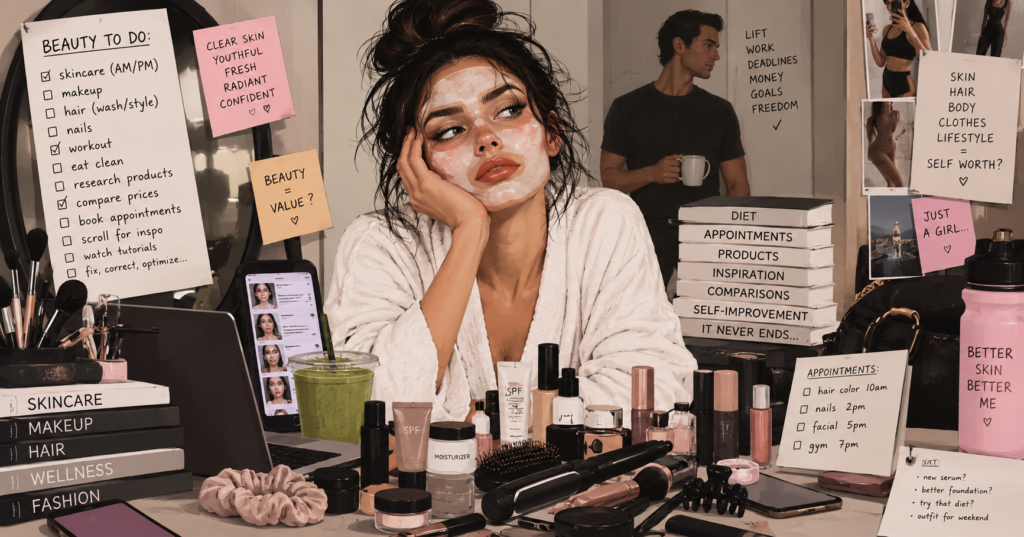
Women spend so much of their lives thinking about beauty. Not just doing makeup or skincare, but planning, researching, comparing, checking, correcting, and optimizing. I’m talking about getting ready, shopping, hair appointments, nails, skin treatments, dieting, scrolling through beauty content, saving outfit inspiration, watching tutorials, and so on. Even women’s downtime is often all about beauty.
But how did we get there? Why don’t men do the same thing?
This article is about why that happens, what it costs, and what we should aim for instead.
Why Women Invest So Much In Beauty
Let’s start with the beginning: the biological asymmetry between men and women. As we all know, men and women face different reproductive costs. Women bear pregnancy, childbirth, breastfeeding, and a much larger minimum parental investment. Men can reproduce with much lower biological cost.
Because of that asymmetry, the sexes evolved to prioritize different signals in mate choice. Men prioritize beauty. The reason is simply that a lot of what we call feminine beauty is just visible cues of youth, health, and fertility. Think about it. Smooth skin and a clear complexion, no wrinkles, red or flushed cheeks, red and full lips, bright eyes, healthy hair, and a lower waist-to-hip ratio.
And makeup often imitates or exaggerates these signals: blush recreates flushed cheeks; lipstick makes lips look redder and fuller; foundation smooths and evens the skin; concealer hides tiredness, blemishes, and age cues; contouring and styling can exaggerate sexual dimorphism.
The waist-to-hip ratio is the waist measurement divided by the hip measurement. Example: if a woman has a 27-inch waist and 39-inch hips, her waist-to-hip ratio is about 0.69. The classic attractiveness research often points to a ratio around 0.7, with some observed ideals around 0.68 to 0.72. But why do we care about women’s waist-to-hip ratio? A smaller waist relative to hips can signal sexual maturity, estrogen-linked fat distribution, and potential fertility. This helps explain why curves are often read as feminine and attractive.
I’m not saying that every man likes the same body. What I’m saying is that certain visible fertility and health cues have become culturally amplified into beauty standards.
Men also have beauty or attractiveness standards. But they are not usually judged through facial perfection, youth, or fertility. So they don’t do skincare, makeup, and constant beautification to the same degree.
Male attractiveness has historically been tied more to status, competence, strength, protection, resources, leadership, confidence, and achievement. A man can become more attractive through social status, money, professional success, physical strength, and reputation. A woman can gain status too, but her appearance is judged much more constantly and much earlier.
Men often signal they’re powerful, competent, respected, and that they can protect and provide. Women often signal they’re young, healthy, attractive, desirable, and high-status through appearance. That’s why men compete more through achievement, dominance, money, cars, careers, houses, leadership, and social rank. While women compete more through beauty, body, clothing, accessories, youth, femininity, and desirability. Both sexes can do both, but the pressure is not equally distributed.
But why did men’s provisioning and protecting become so important? Why are they judged through their status, money, and ability to provide?
See, compared to other mammals, human babies are born earlier. We had to compromise between the ability to walk upright—which means a narrow pelvis—and large human brains. If a human baby stayed in the womb until fully neurologically mature—like a chimpanzee or horse—its head would be too large to fit through the birth canal. So nature resolved this by having humans give birth earlier. Newborns arrive with only about 25% of their adult brain size developed.
What it means is that our babies are physiologically premature and dependent. For a long period after birth, they cannot walk, feed themselves, defend themselves, or survive alone. They need someone. And the mother is essential here because of breastfeeding, and she also has to recover from the pregnancy and birth anyway. Other people can help, and humans are actually cooperative child-rearers, but the mother-infant pair still creates a major survival problem.
Because if a woman is pregnant, recovering, breastfeeding, carrying a baby, or caring for other small children, she has less ability to do physical things, take risks, and spend all day hunting, gathering, or fighting. That’s why male traits like protection, provision, strength, competence, and resource acquisition became valuable. In modern life, providing and protecting became money, career, ambition, competence, and stability.
What I’m saying here about men being attracted to young and healthy women who can bear children and women being attracted to men who can provide and protect them is not only an ancient story. Cross-cultural research has repeatedly found sex differences in mate preferences. The original Buss study in 2019 tested mate preferences across 37 cultures in 33 countries. A larger replication one year later across 45 countries also found the same broad pattern. Men, more than women, prioritize youth and physical attractiveness. Women, more than men, prioritize financial prospects, ambition, and slightly older partners.
But I wanna say something important here. This does not mean every individual fits the pattern or that culture has no role. It just means the pattern appears cross-culturally often enough that we should take it seriously.
This helps explain why older men with status and younger attractive women are a common pairing. It is an exaggerated version of the basic exchange: he has resources, status, and stability, and she is young, beautiful, and fertile. This attraction pattern is not random. It maps onto long-standing sex differences in mate preferences.
The reverse pairing, a much older woman with a much younger man, can happen, especially sexually or romantically. But because female fertility declines with age and male reproductive capacity lasts longer, it didn’t become a dominant pattern because, from an evolutionary standpoint, these couples wouldn’t reproduce and would eventually become extinct.
So women did not invent beauty pressure out of nowhere. Beauty sits on top of biology, reproduction, male desire, female competition, and social status.
The Creation Of The Beauty Industry
So yes, beauty started as a natural mating and status signal. But capitalism turned it into an infinite market. The beauty industry knows that women already care about beauty because it is tied to desirability, status, confidence, and belonging. But if women achieve beauty, the beauty industry stops making money and eventually dies. Because it doesn’t have anything else to sell. So they constantly move the standard. They create demand by creating new flaws and then selling the solution for it.
Let’s take shaving, for instance. Before 1920—just a bit more than 100 years ago—women didn’t shave. They started shaving because Gillette didn’t make enough profits and wanted to expand their market beyond men. And at that time, women’s clothes also started changing. We began to see sleeveless tops and shorter dresses. So it showed more skin. Gillette took advantage of that cultural change to start advertising razors to women, telling them that visible hair was unhygienic and unfeminine.
But after shaving, we had what we started calling “strawberry legs”. Because it was marketed as a problem, lots of companies started selling exfoliants to solve this. But what’s the issue with exfoliating? It can make your skin dry or damage your skin barrier. So now you need a moisturizer. And it just keeps going on and on and on.
There are so many examples like this that we can talk about: pores, skin texture, fine lines, hip dips, dark circles, forehead lines, cellulite, frizz, aging hands, uneven tone, or preventative aging. None of them was a problem until it became one.
A few decades ago, getting ready might have meant washing your face, moisturizing, shaving, doing your hair, and putting on some makeup. Now the routine can include an oil cleanser, a foam cleanser, an exfoliating acid, a toner, vitamin C, niacinamide, retinol, an eye cream, a moisturizer, sunscreen, a lip mask, gua sha, a facial massage, dermaplaning, brow lamination, lash lifts, gel manicures, hair removal, teeth whitening, hair gloss, scalp treatments, red light therapy, collagen supplements, Botox, and fillers. New steps get added, but old steps rarely disappear. So the baseline gets higher every year.
You remember earlier I said that women pursuing beauty comes from evolution and mate choices. But I’m sure you’ve heard many women saying they’re doing it “for the girls and the gays”. Well, they’re not entirely wrong. Women are not only responding to men. Women are also responding to other women. Because they want to achieve status and attract a high-quality mate, they have to compete.
If more women adopt a beauty practice, it becomes the new normal. So social competition makes the baseline feel mandatory. Because once something becomes normal, doing less feels like falling below zero. A woman with no makeup looks tired or neglected because makeup became the expected baseline. A normal forehead looks old because Botox became so common. A normal body can look fat because filters, surgery, posing, and retouching became very common online.
And social media is obviously a huge factor in accelerating all this. A new trend can reach millions of women in a matter of days. So women compare themselves not just to women in their circle or town, but to the most optimized and retouched faces and bodies in the world. So the competition becomes constant, global, and almost impossible to keep up without losing your sanity.
What Beauty Costs Women
Now let’s talk about the cost of doing all this beauty work for women. Let’s start with the obvious cost: money. Beauty is expensive because, as we said, there is no finish line.
Women spend money on skincare, makeup, hair appointments, nails, hair removal, tanning, clothes, shoes, bags, jewelry, accessories, injectables, supplements, and numerous skin treatments. When you add all of this, you can get to hundreds of dollars a month and thousands of dollars a year. The cost is not just one, two, or a few products. It is a whole maintenance system. And within that system, women are never done. It just keeps going on and on.
Besides money, beauty also has a time cost. It might seem obvious, but beauty takes time every day, every week, and every month. And I’m sure most women never reflect on it consciously. They know it takes some time, but they’re never really aware of how much time it really takes. Let’s break it down.
First, you have the obvious. The daily time of skincare, makeup, hair, outfit selection, and checking or fixing your appearance during the day. To that, you add the weekly or monthly time of hair removal, doing nails, going to the hair salon, tanning, dieting, and doing skin treatments. And the most pervasive is the hidden time of looking for outfit inspiration, watching makeup tutorials, researching products, scrolling beauty influencers, saving TikToks, learning and trying new techniques, shopping online, returns, and so on.
I don’t even know if we can conceptualize how much time all of this takes in a woman’s life. Except for work and being with friends and family, that’s practically all most women do. Even when they’re with their friends, they do beauty somehow. They go for a shopping afternoon, they try new makeup techniques, or they talk about new products. If you take all of this out, how much time do you have left? I’m guessing a lot. Probably more than 5 or 10 hours a week, or even more if you have appointments.
That’s the extra time men have for work, skill-building, and physical activity. Now, I’m not saying that men never waste time. They absolutely have their vices. But what I’m saying is that men do not spend all this time just to be okay, just to be presentable, and have some sense of self-worth. And they have more time to do other things not related to their appearance, maybe more useful and valuable.
Beauty does not only take money and time. It also takes attention. Women monitor themselves constantly. They always have these questions running in the back of their head: Does my hair look okay? Is my lipstick still on? Is my skin oily? Is my outfit flattering? Do I look good from this angle? Women check mirrors, shop windows, and phone cameras all the time. Appearance is like a permanent open tab in a woman’s brain.
And that matters because researchers keep telling us that our attention is finite. The mental energy we spend monitoring ourselves is mental energy not available for work, learning, money, creativity, relationships, or just simple presence. Let me give you an example.
In an experiment, researchers split women into two groups. They asked the first group to wear a swimsuit and the second group to wear a sweater. Then, both groups were asked to spend some time looking at themselves in the mirror. After that, they had to complete a math test. The women wearing the swimsuit performed a lot worse. Why?
The interpretation of the researchers was that when women became more self-conscious about their bodies, some of their cognitive resources were pulled away from the task. As I said, you worry about how you look, you notice your cellulite, you start thinking you need to lose some weight, you wonder if your partner still loves you and if he’s probably cheating on you because of that. So the beauty pressure does not stay in the bathroom. It follows women into school, work, and all aspects of life.
The other cost of beauty is that it can cost women their self-worth. Although beauty seems like confidence, it often creates dependence. Yes, women feel more confident after they put on their makeup. But it’s a double-edged sword. Because it also means they can feel ugly without it. When makeup, hair, outfit, and accessories are right, women feel very confident. They feel beautiful, take a picture, and then post it on Instagram. But what about when they wake up? When they’re at home? When they’re at the beach or pool?
Some women may feel like people will think the real them is a scam. If we feel good only when we do beauty work, then it becomes temporary and fake confidence instead of real self-worth. The more we correct, hide, filter, and optimize, the more our natural self can start to feel unacceptable.
Pursuing beauty at all costs can also be a threat to women’s identity. Because trends change constantly: coquette, mob wife, clean girl, old money, etc. So women reinvent their appearance every few months. But if your identity is always outsourced to trends, you never build a stable self. You become a consumer of aesthetics instead of a person with a specific identity. Instead of being a person with taste, values, skills, discipline, convictions, and purpose.
And finally, the last cost for women is the opportunity cost. Every dollar spent on beauty is money that was not saved, invested, or used to build something. And every hour spent optimizing appearance is an hour not spent learning about money, building a career, developing new skills, reading, training, starting a business or a side project, learning a language, creating, deepening friendships, building a community, or resting properly.
The cost of beauty is not only what we lose today. It is who we fail to become 5 or 10 years from now because our resources went into appearance instead of growth. Many women know more about skincare than personal finances. Many women watch more makeup tutorials than videos about money or personal development. Many women spend more time improving their appearance than improving their skills, career, or earning power.
Meanwhile, men often build themselves through money, career, risk-taking, business, investing, skill development, and professional achievement. We need to stop lying to ourselves: the gender pay gap mainly comes from there. If women redirected even part of their beauty budget and beauty time into money, skills, and business, their lives could look radically different in 5 or 10 years.
Because one thing to keep in mind is that looks are powerful, but fragile. We don’t stay young and beautiful all our lives. Trends change. And the market always finds someone younger, someone new, someone fitting the new ideal of beauty. This is obvious in industries built on female appearance like acting, modeling, influencing, sex work, and all careers centered around beauty in general. Women in these industries often complain that they are discarded as they age. But unfortunately, this is what happens when an industry values women primarily for their youth and their beauty.
If all your power is beauty, then your power is on a timer. That is why women need assets that age better: skills, money, a reputation, knowledge, character, relationships, health, and discipline.
So the issue is not that beauty is fake or evil. The issue is that beauty can become a real burden for women’s future. So how do we keep the parts of beauty that genuinely serve us, while refusing to give it our whole life?
What Should Women Do Instead Of Beauty
I’m going to start with what we shouldn’t do. We shouldn’t pretend that beauty does not matter. We cannot turn beauty off completely. Women will always care somewhat about how they look. And men will always respond somewhat to youth, health, and attractiveness. Beauty is part of human life. We’re attracted to beauty. We are surrounded by beauty everywhere in our lives. The goal is not to become careless, resentful, or unattractive on purpose, as many suggest. The goal is to stop making beauty the center of our existence.
A woman’s existence shouldn’t revolve around: What face do I want? What body do I want? What aesthetic do I want? What are the things men find attractive? And how do I rank compared to other women? But every woman should ask herself: What kind of human being do I want to be? What do I know? What can I do? What am I building? How do I think? How do I treat people? What problems can I solve? What kind of life am I creating?
And when you do beauty, my advice is that you create some limits. Don’t let it control you. Choose a simple routine that makes you feel good without swallowing your life. For instance, do basic skincare, simple makeup if you like it, hair that is manageable, and clothes that fit your real life. Exercise for health, strength, and confidence. Stop chasing every new product, treatment, and trend. Stop adding steps just because other women are doing it. And before you buy something, ask yourself: Do I actually need this? What problem is this solving for me? What would this money become if I invested it instead?
You can also create a beauty budget. You decide how much is enough per month. And then you redirect the rest into emergency savings, investments, courses, books, tools, health, or holidays and activities with your friends and family. Hundreds of dollars a month in beauty are thousands of dollars a year. Thousands a year invested over time can become so much freedom, options, and security. Beauty gives us a temporary feeling until a new trend comes up. Money gives us choices.
And if you want to reclaim your time, you can start by auditing how many hours a week go into beauty. Take everything into account: getting ready, appointments, shopping, social media, tutorials, research, comparing, etc. Choose what to keep and what to cut. And then put your reclaimed time into your career, skills, sports, hobbies, health, cooking, reading, building a side project, learning a language, friendships, community, or rest.
In order to reclaim your time and money, you also need to reclaim your attention. Otherwise you’ll always be tempted, and it becomes so much harder. Stop following accounts that make you feel ugly and behind. Accounts that always make you buy more and do more. Follow women who are building, learning, training, investing, creating, leading, and thinking. Change what your brain sees every day. If your feed is only beauty, fashion, bodies, procedures, and consumption, your mind will start to believe that is the whole female project. If you start following inspiring women, you’ll start seeing that everything is possible. Curate your environment so beauty becomes one category of life, not the entire purpose.
Because skills compound in a way beauty does not. Beauty fades or requires more maintenance over time. Skills, on the other hand, become more valuable over time. The skills I believe we should all prioritize are communication, negotiation, writing, sales, money management, investing, leadership, AI, technical skills, business skills, emotional regulation, public speaking, as well as fitness and health knowledge. Become a woman who can do things, not just a woman who’s here just because she looks good.
Apart from skills, I also think that women really need to talk about money more. Many women need to learn how investing works, how taxes work, how salaries work, how negotiation works, how to ask for a raise, how businesses make money, or how to choose a career with earning potential. Often women accept being underpaid because choosing a higher-paying job or negotiating a higher salary or a raise feels uncomfortable. A woman with money, skills, and options is way safer than a woman who is only pretty.
Because at the end of the day, youth will not last. Beauty will change. And every woman needs to build a self that survives that. If your entire identity is being desirable, aging will feel like no one cares about you anymore. You need to build things that age with you, like knowledge, taste, character, strength, wealth, deep relationships, a body that functions, a mind that is alive, a reputation, and a life’s work. The goal is to become more powerful with age, not less.
Beauty can definitely be pleasurable, creative, feminine, and fun. But beauty should not be a prison. Women spend their best hours, money, and attention becoming more desirable. But the real freedom is using some of those resources to become more capable.
You can do enough beauty to feel good. But then go build a life.